
I said it was free. Then I asked for money.
Two years, three AIs, one prompt, and no paying users. An autopsy of ViaTriAi.
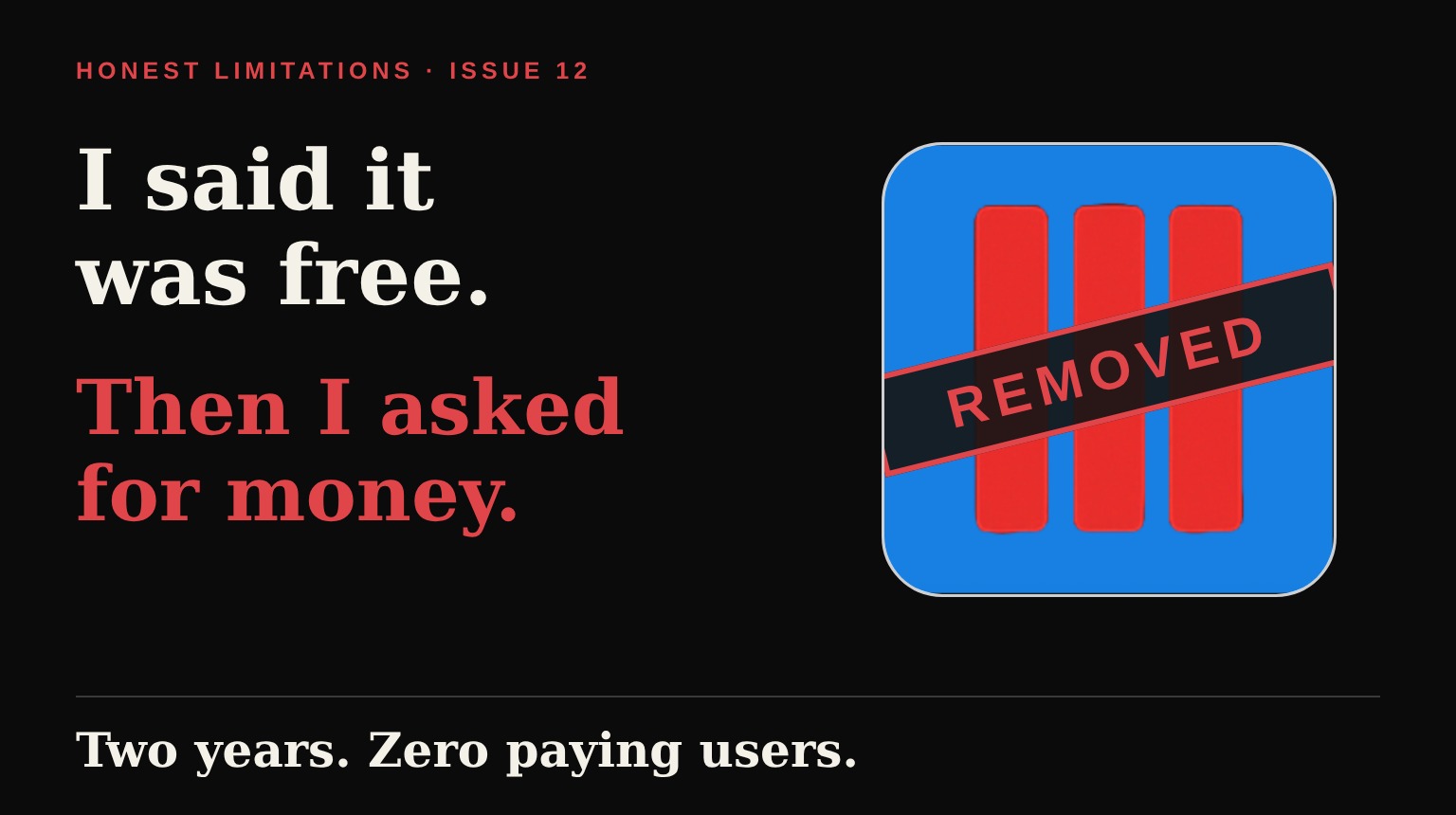
On November 10, 2026, I removed the ViaTriAi app and took its website down.
I worked on it for two years. In that time nobody paid for it. It's another heartbreak, and this newsletter has recorded a few of mine already.
My first explanation was short: a good idea with no market. Then I reread my own ads. This issue is about what I can prove and what I can't.
The app
ViaTriAi worked like a browser for AI. You typed one prompt and got three answers side by side, from ChatGPT, Claude and Gemini. It did the same for images, translation and writing. Over two years I kept adding features. By October 2025 it had 19 built-in experts and SAT prep.
The pitch was a line from my own ad: "Why settle for one answer when you can get three?"
The numbers
Running it cost me between $50 and $200 a month for the AI services and the hosting. Each prompt meant three AI calls, and I paid for all three.
What my ads said
I promoted ViaTriAi on Instagram, TikTok and X. This is from one of my own Instagram posts, dated October 29, 2025:
"No limits. No fees. Just pure AI power at your fingertips. Download now — it's 100% free!"
The picture on that post said "Download now, it's completely free!" A reel two weeks later said "it's FREE, fast, and made for everyone."
Each of those two posts got four likes. One of the four came from my own puzzle account.
Likes don't tell me how many people saw the posts or downloaded the app. I don't have those numbers.
Later I added a subscription. Nobody took it.
Where I failed
I advertised it as free, then asked for money. My ads said "No limits. No fees." Someone who finds a free app can still subscribe later, so the ads alone don't explain the zero. What I can't tell you is how many of my users ever saw the subscription offer. I counted who paid. I never counted who was asked.
"No limits" was a promise I was paying for. The AI behind every answer sent me a bill. Each free user I won made that bill larger and brought in nothing. If the ads had worked better, I would have lost money faster.
I was offering one door to three rooms people could already enter for free. ChatGPT, Claude and Gemini each have a free version. ViaTriAi saved someone the trouble of opening three tabs. That is a convenience. I never tested whether it was a convenience anyone would pay for.
I counted features as progress. Images, translation, writing. Each new feature felt like a step toward a paying customer. None of them tested whether a customer existed.
I know how many people paid. Zero. What I don't know is how many ever saw a price.
What the zero proves, and what it doesn't
In Issue 10 I killed two apps and said people don't want to pay. Fewer than a hundred people had tried them, so I couldn't know that.
This time more people came. By my estimate, between 100 and 1,000 people used ViaTriAi, and none of them paid. That is enough to explain why I shut it down: I paid the AI bill every month, and the app earned nothing.
It is not enough to explain why nobody subscribed. I don't know how many of those users saw the price, so I can't say whether they turned it down or never met it.
It also does not tell me that nobody will pay for a product like this. Other companies offer the same kind of thing, and I don't know their numbers. So "no market" is more than I know. What I know is narrower: mine earned nothing, and I can't yet say why.
I still think removing it was the right call. It cost me money every month, it earned nothing, and I have another product that needs that time and money more.
The Three Gates, applied to me
Is it real? Yes. It worked. One prompt went in and three answers came back.
Is it new? No. Poe, from Quora, opened to the public in February 2023, before I started. It puts models from OpenAI, Anthropic, Google and others in one app. ChatHub, a browser extension, describes itself this way: "Chat with multiple chatbots at the same time, making it easy to compare their answers." I added my own features and my own design, but the core idea was already available.
Does it have a foundation? No. A foundation here means someone who pays, a way to reach them, and a cost I can carry until they do. I paid the AI bill every month. The app earned nothing.
Other people had built versions of the idea before me. I could live with that. What I couldn't keep doing was paying for all three answers myself.
Cause of death: I offered it free with no limits and paid for every answer myself. The subscription I added later earned nothing.
Caught at Gate Three — Does it have a foundation? That gate asks whether something solid sits under the idea: a buyer, a way to reach them, a way to pay for what comes next.
What survived
In Issue 10 I wrote a rule: if an app runs on AI I pay for, I work out who covers that cost before I build. ViaTriAi was already built when I wrote it. That makes three apps I've removed for the same reason: each one cost me more to run than it earned. It is also one rule I learned late.
Two rules come out of this one:
- Put the price in the first ad, and count how many people see it.
- When someone else's AI sits behind your product, know who pays that bill before launch.
ViaTriAi did what I built it to do. It answered a question three ways at once. The question it never answered was who would pay for it, and that one was mine to ask before the first ad went out.
Samir Hanna Safar is an independent inventor with 24 granted U.S. patents. Honest Limitations publishes one failed idea a week — and what survived after it failed.
The user count and the monthly cost are ranges from my own estimates, not exact records. The ad wording is quoted from my own Instagram posts of October 29 and November 14, 2025. Poe's launch date is from its Wikipedia entry, and ChatHub's description is from its GitHub page.
Drafting, computation and formalisation are carried out with the assistance of an AI system. The questions, the direction and every choice are mine, and I take full responsibility for them.