
I killed two apps. My reason was only half right.
I told myself people wouldn't pay. Then I looked at the numbers, and they didn't back it up.
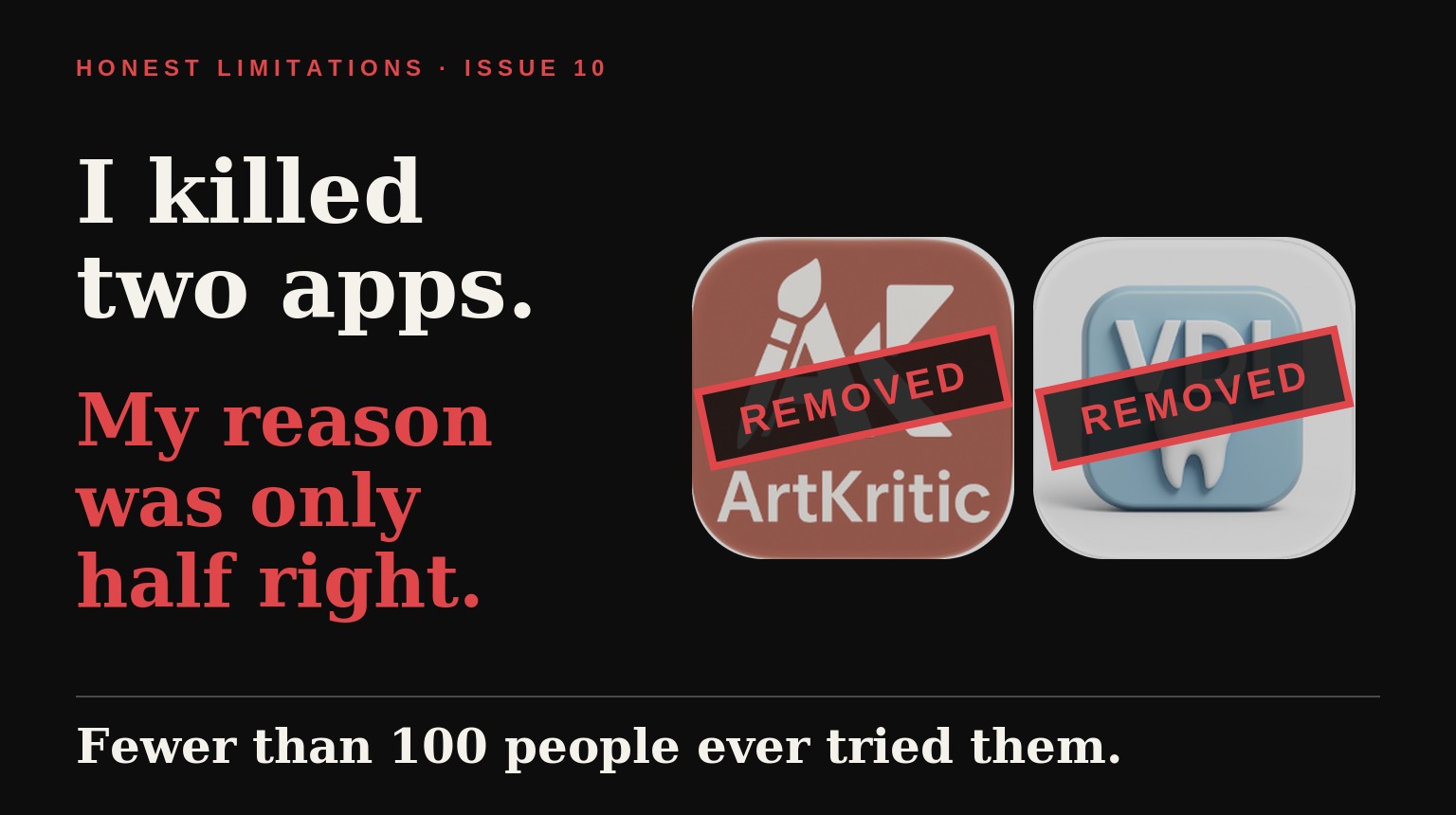
ArtKritic and ViaDentAI are no longer on the App Store. I took them down myself.
ArtKritic used AI to look at a painting and tell you about its balance, its color, and how it hangs together. ViaDentAI used AI to help you learn about your teeth and gums before you saw a dentist. I worked hard on both.
I thought people needed them
I believed people would need them, not just want them. A painter needs honest feedback on a piece. Someone with a dental worry needs to understand it before they see a dentist. ViaDentAI was educational only, never a substitute for a dentist.
So I treated them like real products. I promoted them on Instagram, LinkedIn, and TikTok. I let people use them free, and I added a subscription for the rest.
What the numbers said
Fewer than a hundred people ever used them, across both apps together.
Between one and ten of those people paid. The subscription cost somewhere between three and seven dollars a month.
The AI behind them cost me under a hundred dollars a month for the two. That isn't a lot of money. But at the top of those ranges, the subscriptions could not have brought in more than about seventy dollars a month, before Apple's share. I can't show from these ranges whether they covered the AI bill.
And here's the part I hadn't thought through. The free version ran on AI I was paying for, so free users added to my bill. They weren't free.
What I told myself
I told myself that people don't want to pay for subscriptions. That the cost of the AI was too high for what the apps could earn.
The AI cost was too much for me, and that part I can't dispute. The first part is a conclusion I can't support. With fewer than a hundred users, I never ran a test big enough to settle it. Some people did pay. I can't tell you whether between one and ten out of fewer than a hundred is a lot or a little.
I didn't learn that people wouldn't pay. I learned I hadn't reached enough of them to find out.
"Nobody will pay" is a verdict on the product. "I didn't reach enough people" is a verdict on me.
So why kill them?
Because the decision was still right, just for a plainer reason.
Keeping them alive meant an AI bill every month and promotion on three social platforms. That cost money, and it cost time. I also have one product I believe in: my beach sand removal formula. It needs the attention more than these two apps did.
An app I can't afford to keep running, with almost nobody using it, is a hobby. I had two hobbies and one business that needed me. I stopped feeding the hobbies.
So the honest version is simpler than "the market said no." I didn't prove the apps had no market. I decided I couldn't keep paying to look for one, and I chose where my limited time and money would go.
Cause of death: The free version ran on AI I was paying for, and I never reached enough people to learn whether they'd pay.
Caught at Gate Three — Does it have a foundation? That gate asks whether something solid sits under the idea: a buyer, a way to reach them, a way to pay for what comes next.
What survived
A rule I should have had before I wrote the first line of either app. If an app runs on AI I pay for, I work out who covers that cost before I build anything, and I test that with a small number of real buyers first.
You don't have to prove an idea is worthless before you stop funding it. I'd been treating those as one decision, as if I needed a verdict before I was allowed to quit. Stopping the spending and settling the question are two different things.
And a way of telling two other things apart. "Nobody wanted it" and "nobody found it" look identical from the inside. Only one of them is a reason to stop.
I think stopping was right. I just spent a while believing a reason I hadn't tested.
Samir Hanna Safar is an independent inventor with 24 granted U.S. patents. Honest Limitations publishes one failed idea a week — and what survived after it failed.
User, subscriber, price, and AI-cost figures are my own estimates given as ranges, not exact counts. The earnings figure multiplies the top of the subscriber and price ranges, assumes a monthly plan, ignores Apple's commission and refunds, and is an upper bound.
Drafting, computation and formalisation are carried out with the assistance of an AI system. The questions, the direction and every choice are mine, and I take full responsibility for them.