
I fell in love with a drawing
The invention failed before I built a single part. I didn't realise it for seven months.
The answer was sitting in a five-minute geometry sketch the whole time.
I was trying to make a bicycle easier to pedal uphill.
That was the whole point. Flat ground is fine. It's the climb that empties you out, and I wanted to give something back exactly there.
Not with a motor in the usual sense — with magnets. Arrange them so they pull the crank round on the way down and push it away on the way up, and you get help from the magnetic field as well as from the battery. I want to be clear about the parent idea before I go further: it is a powered assist. Real energy in, real assist out. Nothing free.
Then I had the variant. The one I fell for.
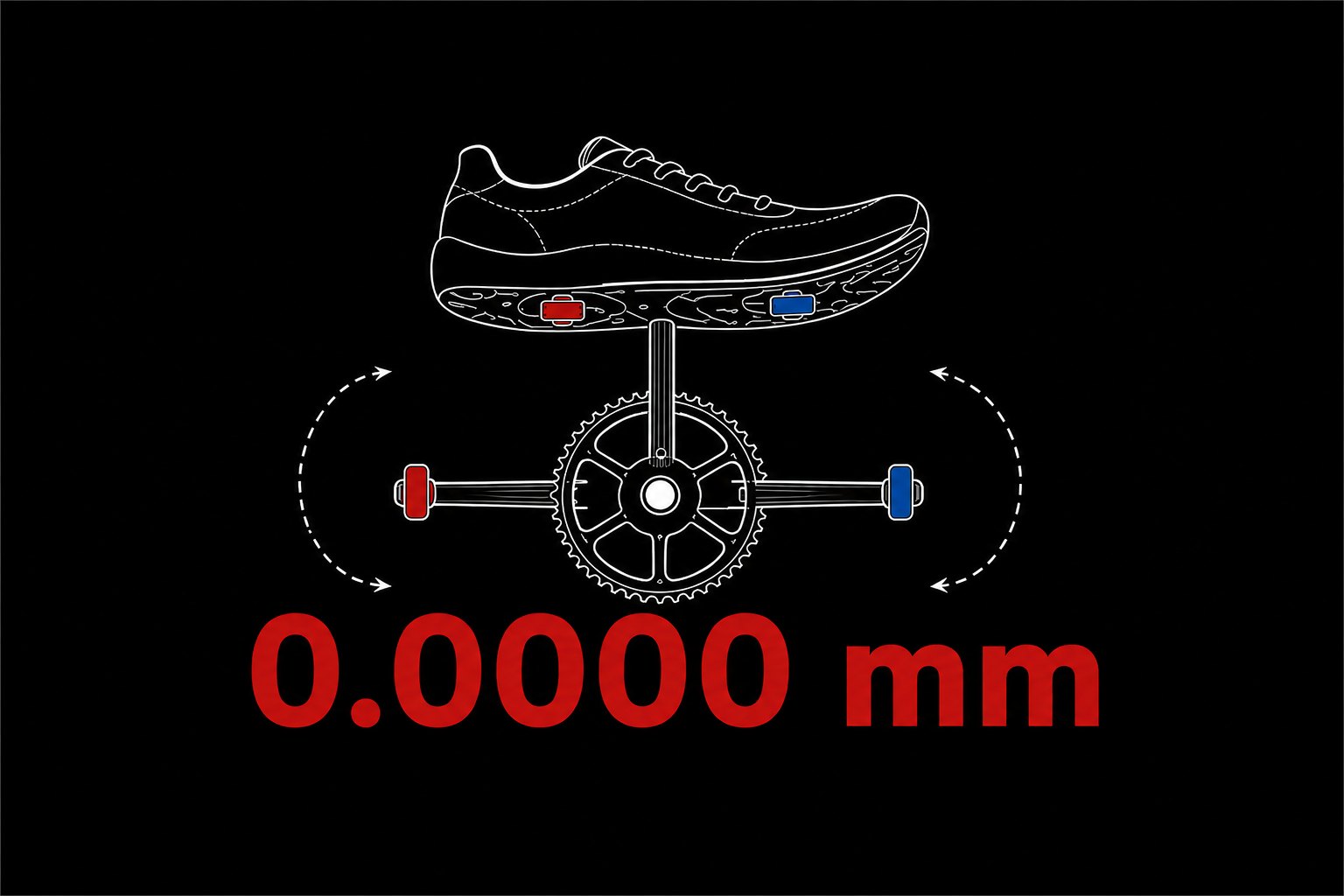
Instead of bolting the magnets to the bicycle frame, put them on the rider's shoes — on the cleats, the little plates that clip your feet to the pedals. A pair of magnets on each shoe. No extra hardware on the bike at all. As the feet go round, the two sets move toward each other and away again, the gap between them opens and closes, and that changing gap is what does the work.
Elegant. Almost nothing to build. It used a motion that was already happening.
I drew it. I drew it several times. I remember thinking it was the kind of idea that looks obvious once you see it — a feeling I have learned to be suspicious of, and was not suspicious of that day.
I wrote it up. I costed the magnets. I sketched the mounting. I gave it its own section in the design record.
The measurement
Eventually I asked the only question that mattered: does that gap actually change?
So I worked out the distance between the two cleats at every position of the crank. Not approximately. Every angle, all the way round.
Here is what the calculation said.
0.0000 mm
Not approximately. Exactly zero.
For a few seconds I was looking for the bug in my calculation instead of the bug in my thinking.
I checked it. Then I checked it again. Then I changed the inputs and checked it a third time, before accepting what the geometry had been telling me from the beginning.
Why it could never move
The two cleats sit on opposite sides of the same rotating crank. They turn together, always half a revolution apart.
Two points on opposite sides of the same turning crank stay exactly the same distance apart. The gap can never open. It can never close.
There is simply no motion there to harvest.
That isn't an engineering limitation, or a tolerance problem, or something a better design would solve. It's a consequence of the geometry — and it was available in the first sketch, in about five minutes, with a pencil, before any of the rest of it.
Five minutes of geometry. Seven months of work sitting on top of it.
I could have settled the whole thing before lunch on the first day.
Then the numbers got worse
Even after moving the magnets elsewhere so the gap did change slightly, the best result was about 0.3 watts of assist, drawn from roughly 6 watts of battery. A reasonably fit cyclist produces around 200 watts, so 0.3 is below the level a power meter can even detect.
The hardware weighed about two kilograms, and carrying that on your feet costs roughly 4 watts on a modest climb.
Which is where it was supposed to help.
The system gave back less energy than its own weight took away — and it took the most away in exactly the situation it existed for.
And there is one more detail I can't tell without smiling. With the magnets on the cleats and the gap never changing, the only mechanical effect the whole apparatus would produce is a steady sideways pull on the rider's shoes.
Seven months. Two kilos of hardware. A battery. And the sole result would have been to gently squeeze your feet.
Beauty is not evidence
What I got wrong wasn't the physics. The physics was fine, and I checked it.
What I got wrong was treating the elegance of the drawing as evidence about the mechanism.
The idea felt right. It was economical. It reused a motion that was already there. It had the quality good engineering has, where nothing is wasted. And every one of those is a fact about the drawing — about how satisfying it was to look at — not a fact about whether a distance changes.
Beauty in a design is valuable, because it often points toward truth. But beauty is not evidence.
I let one stand in for the other, because the drawing was pleasant to look at and checking would have risked spoiling it.
Close the branch with a number
Two things survived, and I use both constantly.
The first: compute before you build. Every idea has a question hiding inside it that can be answered on paper, cheaply, before anything gets made. Find that question first. Mine was: does this distance actually change? Five minutes. I asked it last instead of first, and the order cost me seven months.
The second is the one I'd give away if I could only keep one.
Close the branch with a number.
I didn't merely abandon the cleat design. I wrote it up — the geometry, the 0.0000 mm, the watts, the weight penalty — and one line at the end: Branch closed.
That isn't bookkeeping. It's a message to myself at two in the morning, two years from now, when this idea comes back looking fresh and clever, the way abandoned ideas always do. Without the number I'd chase it again.
Ideas you walk away from come back. Ideas you kill with a measurement stay dead.
The parent project survived too, honestly framed: a powered assist and a physics demonstrator. Real energy in, real assist out. Every joule from the battery. Not free energy, and I won't describe it as one.
Cause of death: I never measured the assumption.
Caught at Gate 3 — Does it have a foundation?
Samir Hanna Safar is an independent inventor with 23 granted U.S. patents. Honest Limitations publishes one failed idea a week — and what survived after it failed.
Drafting, computation and formalisation are carried out with the assistance of an AI system. The questions, the direction and every choice are mine, and I take full responsibility for them.