
Beautiful — and meaningless
For a few days I thought I had found something. Then I ran the one test I'd been avoiding.
I'll spare you the mathematics. It isn't the point, and the story works without it.
I was looking for a hidden pattern in prime numbers. Nobody asked me to. There was no grant, no deadline, no colleague waiting on the result. It was a private thing I'd been picking at for months, the way some people work at a crossword — except this one had lasted years, and I'd built myself a small machine to help. Feed numbers in one end, turn the handle, read the result off the other.
One evening the machine gave me a number that wouldn't move.
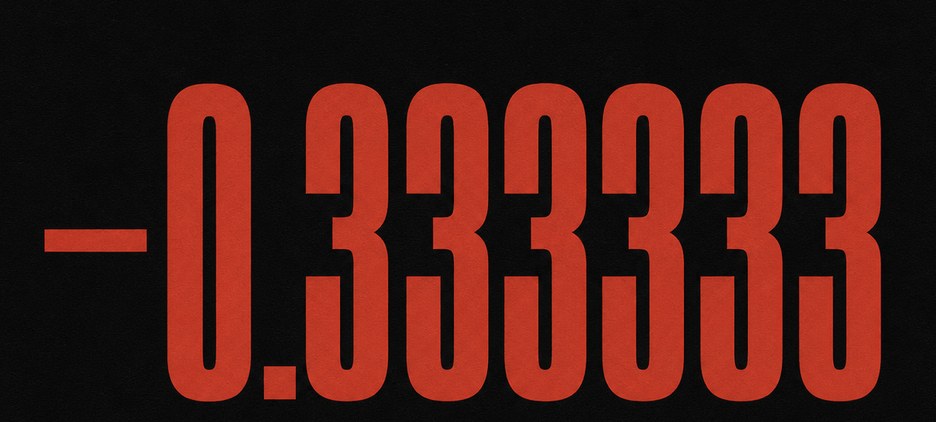
−0.333333
I made the batch bigger. Same answer. Ten times bigger. Same answer, right down to the seventh decimal place. I tried it four different ways, across sizes spanning orders of magnitude, and every single time it came back identical.
If you've never done this kind of work, let me explain why my hands were not entirely steady.
Numbers in this business are restless. They drift. You double your sample and the answer wobbles in the third decimal place, then the fourth, settling slowly if it settles at all. That's what noise looks like, and you spend most of your life looking at it.
So when a number refuses to move — when you change everything around it and it just sits there, unbothered, to seven decimal places — that is the fingerprint of something real underneath. Something that was there long before you showed up and will still be there after you're gone.
I didn't tell anyone. That's the first thing I noticed afterward: that I had wanted to, and hadn't. Saying it out loud would have made it a claim, and a claim is something a person can test.
I sat with it for a few days. I started thinking about what to call it.
The test I didn't want to run
There's a step I make myself perform. I've made myself perform it for years, on everything, and I nearly skipped it this time.
I want to be precise about that, because it's the honest part of this story. I didn't forget. I didn't overlook it. I knew exactly which test I hadn't run, and I found reasons not to run it yet. Good reasons. Reasonable-sounding ones. I told myself I'd tidy up the code first. I told myself the result was so clean it hardly needed checking.
That is what it feels like from the inside. It doesn't feel like avoidance. It feels like sequencing.
The test itself is embarrassingly simple: feed the machine something that couldn't possibly contain what you're looking for, and see what comes out.
If my number really came from primes, then data with none of that structure in it should produce garbage. Noise. Anything except −0.333333.
So on a Thursday I stopped finding reasons, and I ran it.
Same number. Same stubborn stillness. Seven decimal places.
I knew before I opened the code that the mistake was going to be mine.
What I had actually found
Picture a bathroom scale that reads 150 pounds. You step on it: 150. Your neighbour steps on: 150. A bag of flour: 150. Nobody on it at all: still 150.
That scale isn't extraordinarily precise. It's broken. It was always going to say 150.
That was my machine. Somewhere in the way I'd built it, without ever noticing, I had guaranteed the answer. It was going to print −0.333333 no matter what I put in. I had fed it prime numbers and been moved by the fact that it printed −0.333333.
The stillness that convinced me wasn't evidence of anything deep underneath. It was evidence that my machine had one moving part fewer than I believed it did.
I sat looking at that for a while.
I wasn't devastated, and that surprised me. What I felt was closer to embarrassment, and underneath the embarrassment, something almost like relief — the relief of a door closing, of not having to wonder anymore.
But there's one part I still turn over, some nights.
Every extra test I ran had made me more confident. And every one of them was measuring the same mistake again.
That's what makes this kind of error so dangerous. It doesn't feel like being wrong. Being wrong feels like confusion, like things not fitting. This felt like the opposite. It felt like being right, repeatedly, with increasing precision. The more carefully I checked, the more certain I became — because I was checking the wrong thing more thoroughly each time.
I had spent months building a case against myself and calling it evidence.
Why I'm telling you this now
I've been inventing things for thirty-two years. Twenty-three granted U.S. patents, my name alone on every one of them. And somewhere around two hundred ideas that didn't make it — I kept the records on those too, which is a strange habit, and this newsletter is what it's finally for.
Working alone has a particular hazard. There is nobody in the next room to say "wait, show me that again." No colleague who idly asks the one question that ends everything. The discipline has to come from inside, and the person it has to work on is the one person in the building most invested in the answer being yes.
For most of those thirty-two years this would have been a mildly interesting cautionary tale — something you tell over dinner and everyone nods. It isn't that anymore.
Having an idea used to be the hard part. You needed the training, the reading, the years, the taste for it. That was the bottleneck, and it was a real one — it meant most bad ideas died quietly before anyone had to evaluate them.
For producing things that look like ideas, that bottleneck is gone. Anyone with a laptop can now generate, before lunch, twenty of them — well-formed, confident, plausibly worded, beautifully laid out. Some will be excellent.
Most of them will be a bathroom scale that always says 150.
So the scarce thing is no longer the idea. It's the ability to look at something beautiful and work out whether it's actually there. And I see no reason to think that skill got more common in the last two years. If anything the flood has made it rarer, because nobody has time to check anything properly anymore.
I use AI every day. I say so in my published work and in my patent filings, including in my inventor's declaration to the patent office, in more detail than anyone asked for. It has made me faster at everything I do. Faster and more reliable are not the same thing, and in my own work, becoming faster has not automatically made my conclusions any better.
Three questions
Everything I've learned about this comes down to three questions, asked in this order, before an idea gets a dollar, a day, or my belief:
Is it real? Not can I find more support for it — you can always find more support. Can I build a test designed to destroy it, and does it survive? Feed the machine something that shouldn't work, and see what happens.
Is it new? Or am I walking a path someone already walked, in my own handwriting? And when something looks unusually strong, go hunting for the boring explanation first. There usually is one.
Does it have a foundation? Is there a reason this causes that — or do two things merely resemble each other? Most good-looking ideas die right here, because resemblance is easy and mechanism is hard.
What survived
The number didn't survive. The habit did, and I wouldn't trade it back for the number.
I now run the destroying test first, before I've had time to grow attached to anything. Twenty minutes at the start. Months if you leave it to the end — I know exactly how many, because I left it to the end.
And I keep the wreckage. I don't delete failed work. In research it saves the next person the year you just spent. In patent work the value is narrower than people assume — the statute says plainly that patentability doesn't turn on how you arrived at the invention, and the doctrine about failed attempts concerns the failures of others in the field, not your own notebooks. But a clean record of what you tried is still what you want in your hands when someone reconstructs your invention as obvious in hindsight. Either way, the failure is the one thing you definitely earned, and deleting it is throwing away the only souvenir of the trip.
So that's what this is. One dead idea a week — mine — taken apart in public. What I believed, what killed it, and what was left standing afterward.
I have about two hundred of them.
This was the first.
Cause of death: I never asked whether the primes were doing any of the work.
Caught at Gate 1 — Is it real?
Samir Hanna Safar is an independent inventor with 23 granted U.S. patents. Honest Limitations publishes one failed idea a week — and what survived after it failed.
Drafting, computation and formalisation are carried out with the assistance of an AI system. The questions, the direction and every choice are mine, and I take full responsibility for them.