
My tape held. I couldn't find a supplier.
A patented, field-tested snow-chain device. An autopsy of the one part I couldn't get made.
If you have ever knelt in slush behind a car, fingers numb, trying to drape a steel chain over a tire you can't see the back of, you already understand the problem.
Snow chains work. Putting them on is the hard part. For an older driver, or anyone without much grip strength, it isn't a nuisance. It's a wall.
This issue is about the device I built to take that wall down, and why I chose to let its patent lapse this month.
The idea
My answer was simple to say: slap it on the tire and go. No chains to wrestle around the wheel. No jacking. No crawling.
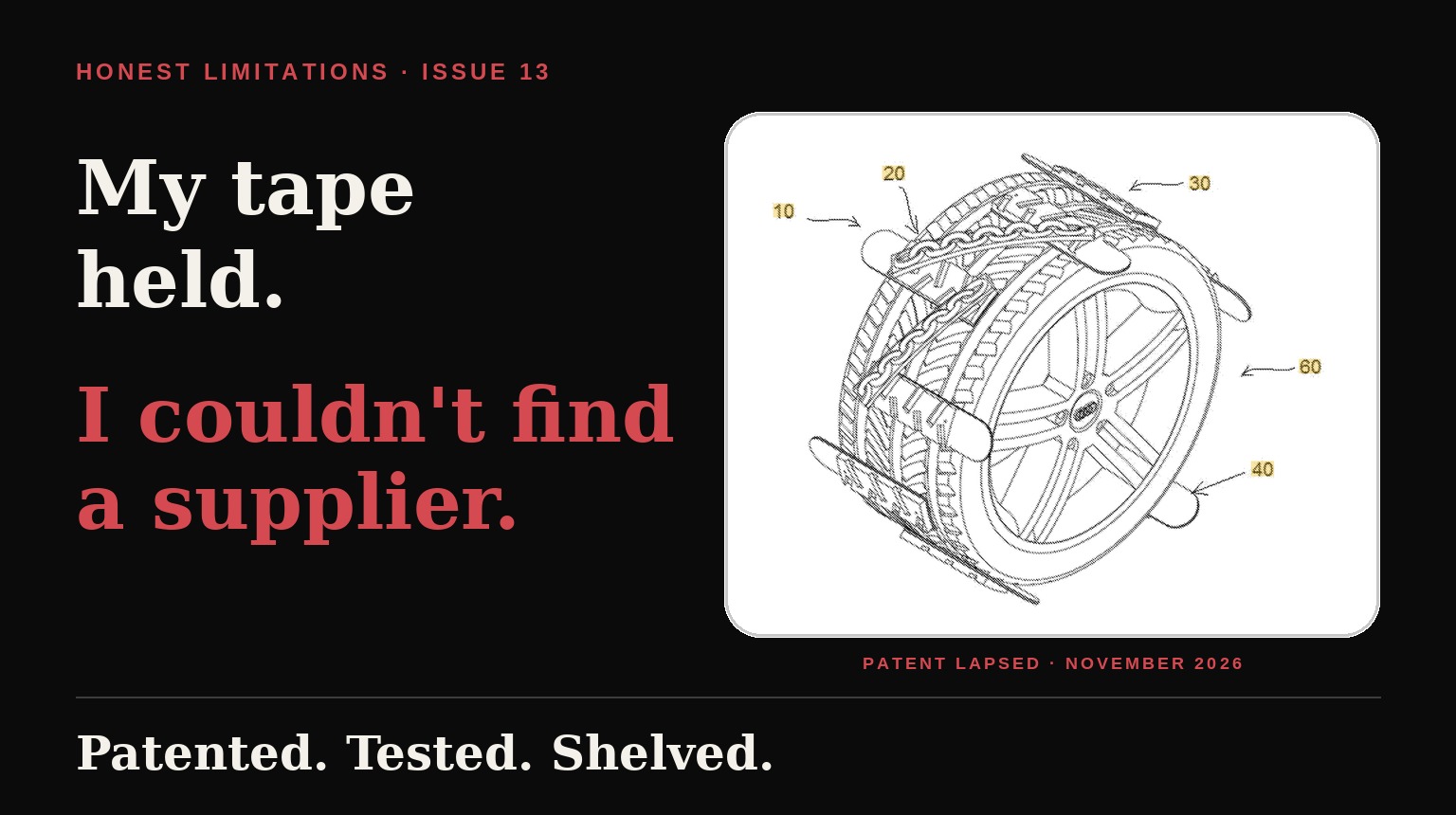
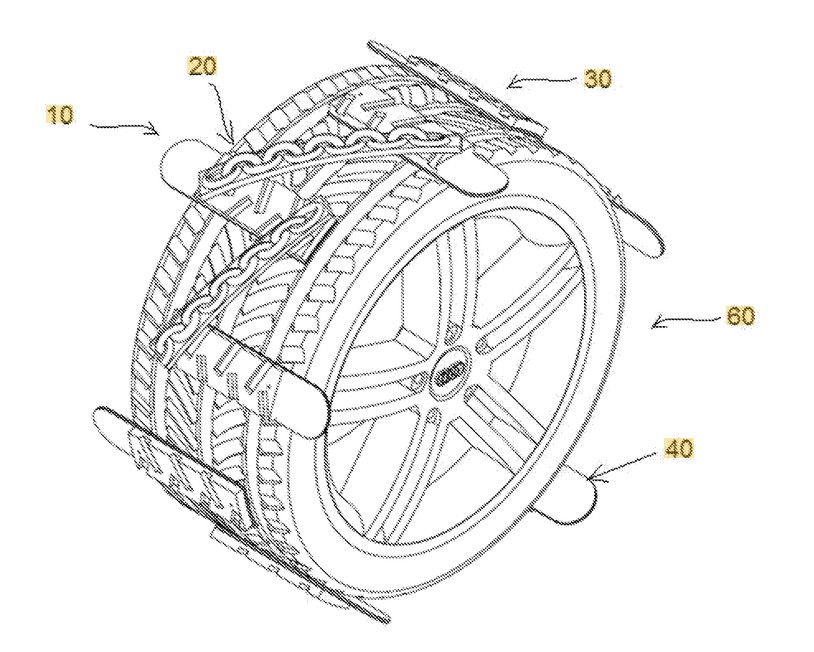
The device has two parts. Flat base plates stick to the outside of the tire with double-sided adhesive strips. Short chain segments, each mounted on an arched carrier with pegs underneath, snap into holes in the base plates. You can cover the whole tire or just part of it, stack layers for deeper bite, and arrange the segments in different patterns for different conditions. The plates and chains are reusable. The adhesive strips are not; you use a fresh set each time.
I called it Stuck Rescue.
What I actually built
This wasn't a sketch on a napkin. I filed the patent application myself on January 8, 2017. It was granted on November 6, 2018 as US Patent 10,118,449, "Snow chain device for vehicle tire."
We tested it on snow and on mud. It worked. It gave traction where the bare tire spun. I named it and built the brand. When the tire got traction, I thought I was close to selling it.
By the measures an inventor usually brags about, this one was a success. It was real, it was new, and it did what it said. Then I tried to get someone to manufacture the strip.
Why I killed it
The adhesive was the product, and I couldn't get it made. My own patent names exactly one material: 3M Command double-sided strips, given as the example adhesive. That one line was the whole business. The chains, the plates, the snap-fit all depend on a strip of tape holding a steel chain to a rubber tire that is spinning, flexing and throwing slush.
My own double-sided tape held. I made it, and it was strong enough to pass our snow and mud tests. But a tape I make by hand for a test is not a tape I can sell by the thousand. To sell it, the strip needed an industrial adhesive, made the same way every time, by a company like 3M. I could not get 3M to supply me. I went to suppliers in China. Their tapes were nowhere near strong enough.
Safety testing I couldn't afford. If a chain segment lets go at speed, it becomes a projectile, and the car loses traction at the exact moment the driver was counting on it. A product like that has to prove itself through safety testing, and that testing costs far more than the $10,000 I had already put in.
Regulation. On top of the testing, there were the rules a traction device has to meet before anyone can sell it. Each one was another bill and another delay, paid before selling a single unit.
So I stopped, and this month I chose to let the patent lapse. I didn't pay the 7½-year maintenance fee, and its six-month grace period ended on November 6, 2026, eight years to the day after the grant.
I proved the strip could hold. I never found anyone who would make it hold every time.
The Three Gates, applied to me
Is it real? Yes. It worked on snow and mud, on the ground, not in a simulation.
Is it new? Yes. The USPTO examined it and granted it.
Does it have a foundation? No. And this is the lesson.
Gate Three asks whether there's a mechanism under an idea, or only a resemblance. Stuck Rescue had a mechanism: I could explain exactly why it worked. In Issue 11 I stretched the gate to the business underneath a product. Here it stretches one step further, to manufacturing. The question I'd left out was who would make the next thousand strips.
Stuck Rescue passed the two gates that inventors celebrate and failed the one nobody photographs. I could make the strip. I couldn't get it manufactured. A product's foundation isn't whether the critical part works once on your bench. It's whether someone will make it for you, the same every time, at a price you can sell. Claim 1 of my patent included the adhesive strips. Eight years later, I still had no supplier for the strip I needed.
Proving a part and producing a part are different problems. My prototype answered the question "Can a strip hold a chain to a tire?" Yes. The market asks a harder one: can every strip, in every box, from every batch, hold? That answer belongs to whoever makes the adhesive, and I never had anyone to make it.
There's one more crack. I designed this for elderly and weaker drivers. That's the right person to help, and it's also the person for whom a failure is most dangerous. A chain segment coming loose from a moving tire could hurt someone, and I couldn't afford the testing I believed the device needed. I should have priced that in from day one.
Cause of death: The whole product hung on one adhesive strip, and I never secured a manufacturer who would make it.
Caught at Gate Three — Does it have a foundation? That gate asks whether something solid sits under the idea: a buyer, a supplier, a way to pay for what comes next.
What I'd tell you before you spend $10,000
Before you build the clever part, find the boring part your idea can't live without: the material, the supplier, the certification. Get a yes on that first.
- Get a sample.
- Get a quote.
- Get it in writing.
- Test the boring part under the worst conditions your customer will face.
If I had the first $500 to spend again, I'd spend it on one question for a tape manufacturer: "Here's the strip that held in my test. Can you make me a thousand, and what would they cost?"
I spent more than $10,000 before I had an answer to that question.
Samir Hanna Safar is an independent inventor with 24 granted U.S. patents. Honest Limitations publishes one failed idea a week — and what survived after it failed.
Filing and grant dates are from the public record for US 10,118,449. The decision not to pay the maintenance fee is mine. The $10,000 figure is my own total for development and is not itemised.
Drafting, computation and formalisation are carried out with the assistance of an AI system. The questions, the direction and every choice are mine, and I take full responsibility for them.