
I loved it. That wasn't enough.
Three years, 500 boxes, about 80 sold. An autopsy of a board game I still love.
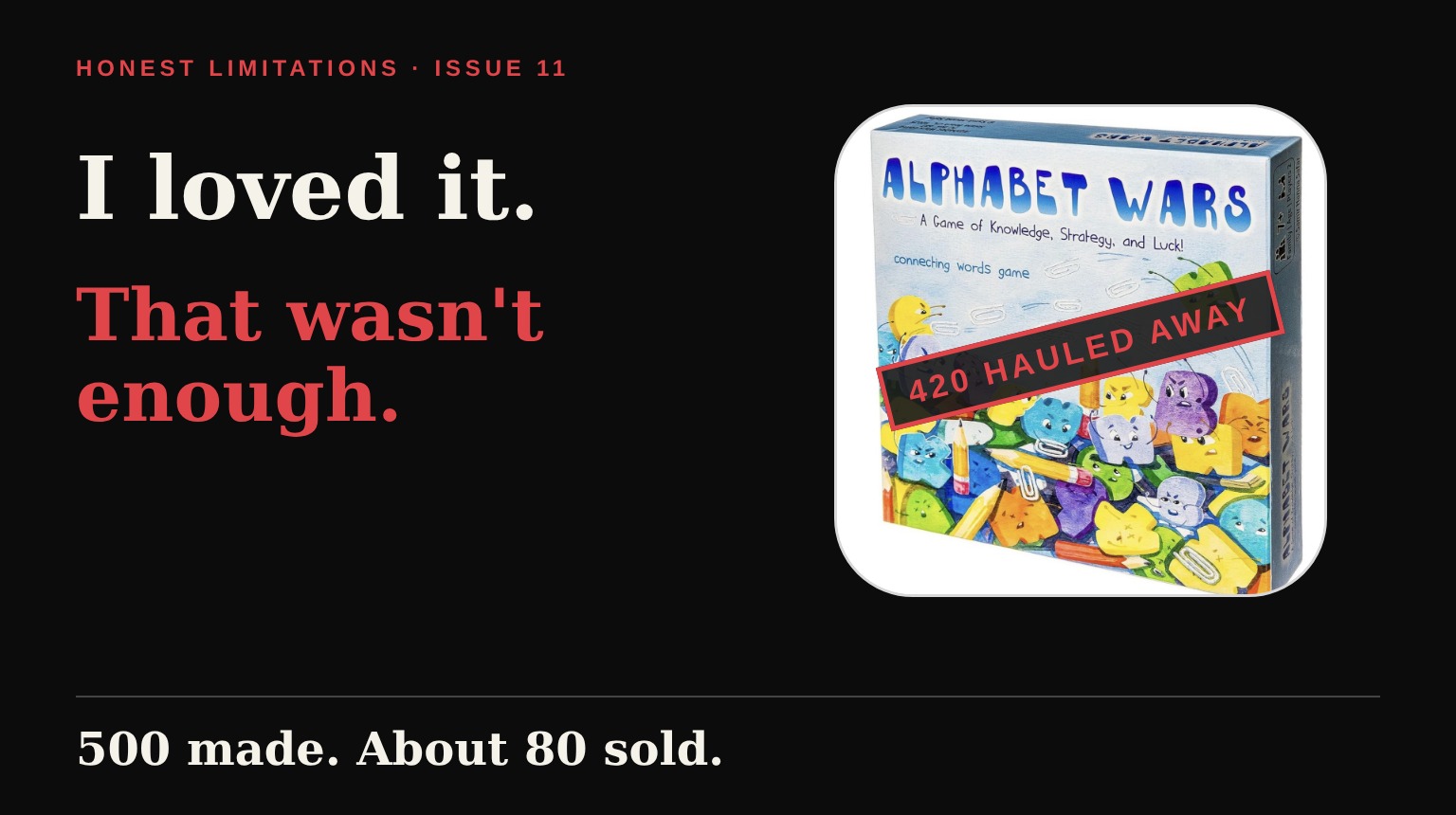
Two years ago I called a hauler and asked them to empty my storage unit.
Inside were 420 copies of a board game I had invented, designed, tested, manufactured in China and trademarked. I had been paying rent every month to keep them there. They weren't being stored anymore. They were being kept alive by my hope.
I watched the boxes go onto the truck, and I had tears in my eyes. I truly believed that game was revolutionary.
This issue is about why it didn't sell, and why loving it didn't help.
The game
Alphabet Wars is chess played with words. Each player builds a chain of words out from their own base line toward the other side. Each side has one large tile, the Ultimate Vowel, which works like a king. You win by spelling a word through your opponent's vowel or by walling it in with your words. Dice limit how long your next word can be, so luck and strategy share the board.
I spent three years on it, revision after revision. I hired graphic artists, tested it at the table, trademarked the name, had it manufactured in China, listed it on Amazon, and hired people to market it there.
The numbers
Producing and bringing 500 copies into my storage unit cost about $7,000. That's about $14 a copy just to get them in the door.
That figure doesn't include what came after: monthly storage rent, shipping to Amazon, Amazon's fees, Amazon's own storage charges, and the trip back when Amazon returned the unsold copies to me. I don't have exact numbers for those costs. I do know the result: after Amazon's costs, selling there lost me money.
Only about 16% sold. I never gathered enough evidence to know how much of that was poor visibility, how much was the learning curve, and how much was simply a game people didn't want enough to buy.
Where I failed
I paid the factory before strangers paid me. I tested the game. I never tested the market. Preorders or a crowdfunding campaign take effort and promotion too, but they could have tested whether people would pay before I committed to 500 copies.
I listed it on Amazon without an audience. I put the game on Amazon without first building an audience that understood why it was worth playing. I hired marketing people to close that gap. I don't have the numbers to say what that marketing returned, but I know Amazon cost me more than it earned me.
I asked families to learn a lot. My rulebook runs 36 pages, and the box holds eight kinds of pieces: letters, vowels, spacers, erasers, pencils, dictionaries, dice and racks. I was asking families to learn a lot before they could start enjoying the game. I even wrote it on page 4: "This board game demands patience and learning." I needed to make the experience easier to see, understand and try.
I told the wrong story on the box. My box said "A Game of Knowledge, Strategy, and Luck!" and "connecting words game." Both are true, and both could describe a hundred games. The real hook fit in one line: Chess with words. Capture their vowel. I never led with it.
I committed to 500 copies before I knew what strangers would struggle with. The game was tested, revision after revision, but mostly by people I could explain it to. I never watched enough strangers open the box and learn it without me in the room. That would have shown me where the game was hard to learn before I paid for 500 copies of it.
I tested the game. I never tested the market.
Love didn't help
I loved this game, and I still do. Love is the reason it exists at all. Nobody spends three years on something they're lukewarm about.
But look at what love did after the game was finished.
Love called it revolutionary before strangers had a chance to judge it. It took every good test game at my own table as proof of a market. It paid the factory, and it kept paying the storage bill month after month. And it kept me from asking the one question that mattered: who, besides me, wants this badly enough to pay for it?
Love is a good engine for building. It is a poor judge of what you've built. The same feeling that carried me through revision after revision kept me from hearing what 420 unsold boxes were telling me.
The Three Gates, applied to me
Is it real? Yes. It plays, it works, and it's still available today in my app.
Is it new? I found earlier games that combine words and conflict. There are U.S. patents tracing back to a 1992 application for a "word forming board game including elements of conflict." There is Wordbase, a 2014 mobile game where players build words from their own side toward the other. My mix of a capturable vowel, words tied back to your base, and erasing an opponent's words may have distinctive features. But I haven't established that nobody did it before me. Revolutionary? No.
Does it have a foundation? The design does. The business never did. That plan was hope, a warehouse and a monthly bill.
So here is my honest verdict. I still believe Alphabet Wars is a good game. What I failed to establish was whether enough strangers agreed, and would pay for it.
Cause of death: I made 500 copies before I knew whether strangers would learn the game, want it, and pay for it.
Caught at Gate Three — Does it have a foundation? That gate asks whether something solid sits under the idea: a buyer, a way to reach them, a way to pay for what comes next.
What survived
The boxes are gone, but the game isn't.
Today Alphabet Wars is in my SamZ puzzle app on the App Store. People can play each other remotely or play against the AI. The rulebook is still on Amazon's book store.
The app removes the inventory problem and handles the rules. It doesn't answer the question I failed to ask before: will people choose to play, and keep coming back?
It does give me something the boxes never could: a game that can keep changing. As I learn from players what's confusing, slow or missing, I can improve it in an update instead of reprinting 500 boxes.
If I could hand one list to anyone holding a beautiful idea and a factory quote, it would be this:
- Test whether people will pay before you make inventory.
- Build an audience that understands the product before you put it on a shelf.
- Make it easy to see, understand and try.
- Lead with one line.
- Let love build it, and let evidence judge it.
I built Alphabet Wars for family kitchen tables. It never reached the number of kitchen tables I had imagined. I'm still sad about the boxes. I'm not sad about the game.
Samir Hanna Safar is an independent inventor with 24 granted U.S. patents. Honest Limitations publishes one failed idea a week — and what survived after it failed.
The $7,000 covers producing the 500 copies and bringing them into storage. It excludes storage rent, shipping, Amazon fees and returns, for which I don't have exact figures. Copies sold is my own estimate. The $14 per copy divides the $7,000 by the 500 copies made.
Drafting, computation and formalisation are carried out with the assistance of an AI system. The questions, the direction and every choice are mine, and I take full responsibility for them.