
I killed the product. Then the patent came.
The USPTO granted the patent on a product I'd already given up on. So was killing it a mistake? Here's my answer, and why I can't prove it.
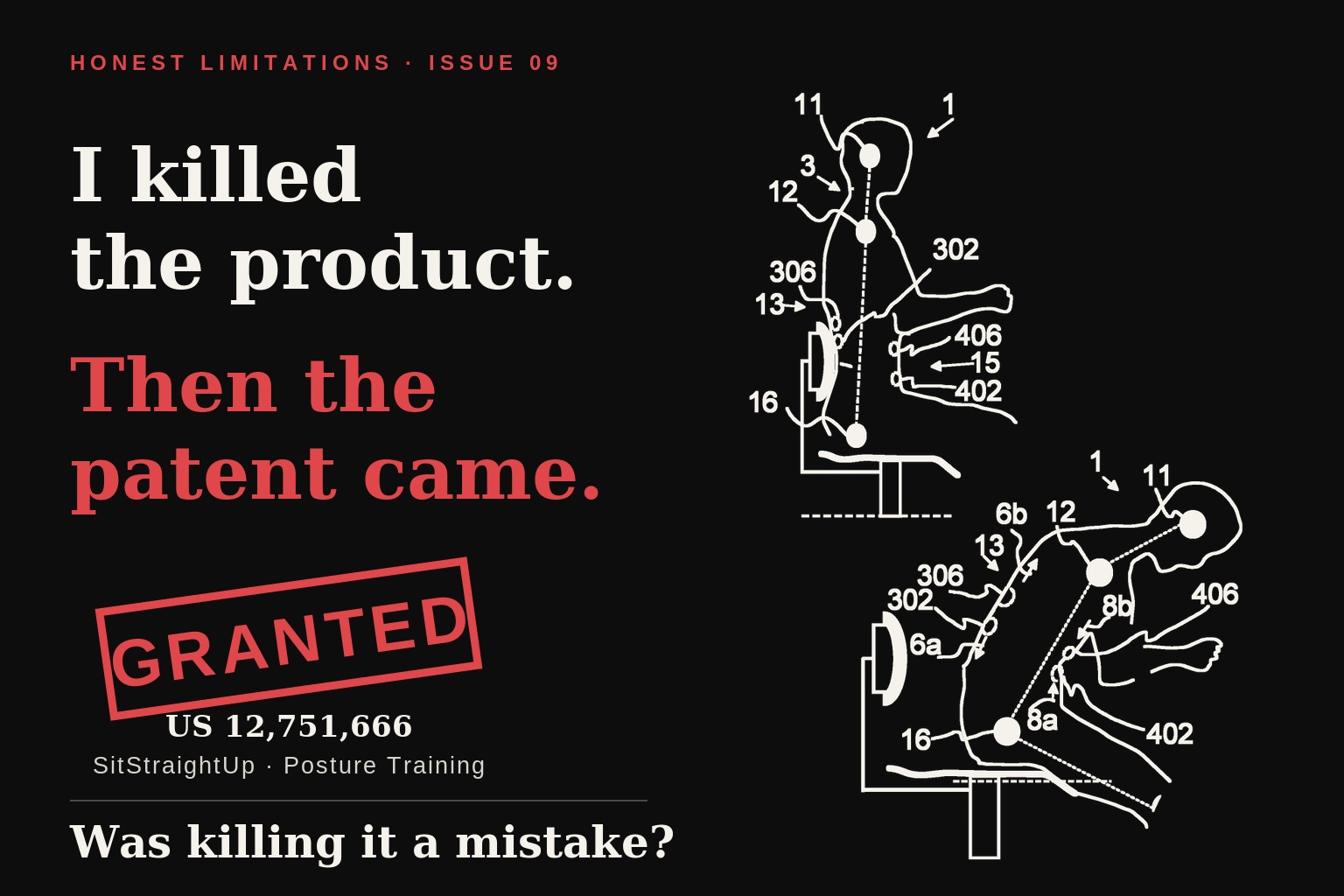
On October 6, 2026, the U.S. Patent and Trademark Office granted me US 12,751,666, titled "Posture Training." It's the one part of this story with a clean ending. Everything else needs explaining.
The product was called SitStraightUp. Two adhesive pads stick to your back, joined by a stretchy strip. When you slouch, your skin pulls on the strip, and a small arm with a soft brush on the end touches your skin until you sit back up. No battery. No app. No screen.
I didn't stop at the idea
In the last issue, I wrote about an invention I filed a patent application for but never built. This one went the opposite way.
I registered the name SitStraightUp. I did the engineering, the molds, the parts, the packaging. I opened an Instagram account, @sit_straight_up, and announced the product there, on X, and on LinkedIn. I listed it for sale on Amazon, Etsy, and Walmart.
Then I tried to license it to a company that sells products like this. Nothing came of that.
So I killed it.
Then the patent issued
I'd filed the application on August 11, 2023. It was published in February 2025. It was granted about thirty-eight months after I filed.
I'd stopped selling, but I'd kept the application alive. That's the decision I now need to explain.
So was killing it a mistake?
The case that it was: a granted patent is a different object from a pending application. When I tried to license the product, I was pitching an application that might or might not ever issue. Now it's issued. I can't know whether that would have changed a single answer I got. It might have.
The case that it wasn't starts with what the examiner actually checks. Is this new? Is it more than an obvious variation on what came before? Is it described well enough to build? Those are real questions, and I'm glad the answer was yes. But nobody there asks whether anyone wants it.
A patent grants rights. It does not deliver customers.
It's also worth reading what I was actually granted. Nine claims, two independent. Claim 1 includes a separate brush that clips onto the arm; claim 3 doesn't need one. I can't judge the patent's commercial value from the grant alone.
What I think
I think killing the product was right, and I can't prove it.
I tried to license it while the application was still pending. Would an issued patent have changed the answer? I don't know, and I have no evidence that its pending status was what ended the conversation.
Here is what I'm sure of. Killing a product and abandoning a patent are two separate decisions, and I had been treating them as one. In Issue 08 I walked away from the application. Here I walked away from the product and kept the application, and that is why a patent exists. Keeping one alive means paying fees due at three and a half, seven and a half, and eleven and a half years after grant. That's a schedule. It isn't a business.
Cause of death: It became a real, granted invention but never a business — and a patent can't tell those two apart.
Passed Gate Two — Is it new? The examiner agreed. Failed Gate Three — Does it have a foundation? That gate asks whether something solid sits under the invention: a buyer, a way to reach them, a way to pay for the next step.
What survived
A granted patent, a registered name, and a question I can't close yet.
If someone licenses it, that may mean keeping the patent alive was worth it. It would not, by itself, mean I should have kept selling the product. If nobody does, I'll say that here too.
Ask me again in five years.
Samir Hanna Safar is an independent inventor with 24 granted U.S. patents. Honest Limitations publishes one failed idea a week — and what survived after it failed.
The patent is real: US 12,751,666 B2, "Posture Training," application 18/233,062, filed August 11, 2023, published February 13, 2025 as US 2025/0049392 A1, granted October 6, 2026, with a patent term adjustment of 388 days under 35 U.S.C. 154(b). I am the named inventor. The description of the claims above is a plain-language paraphrase, not legal advice.
Drafting, computation and formalisation are carried out with the assistance of an AI system. The questions, the direction and every choice are mine, and I take full responsibility for them.