
The patent examiner wrote back. I didn't.
The application was still open, waiting on a response only I could give. I asked myself what answering it would actually buy me — and let the deadline pass instead.
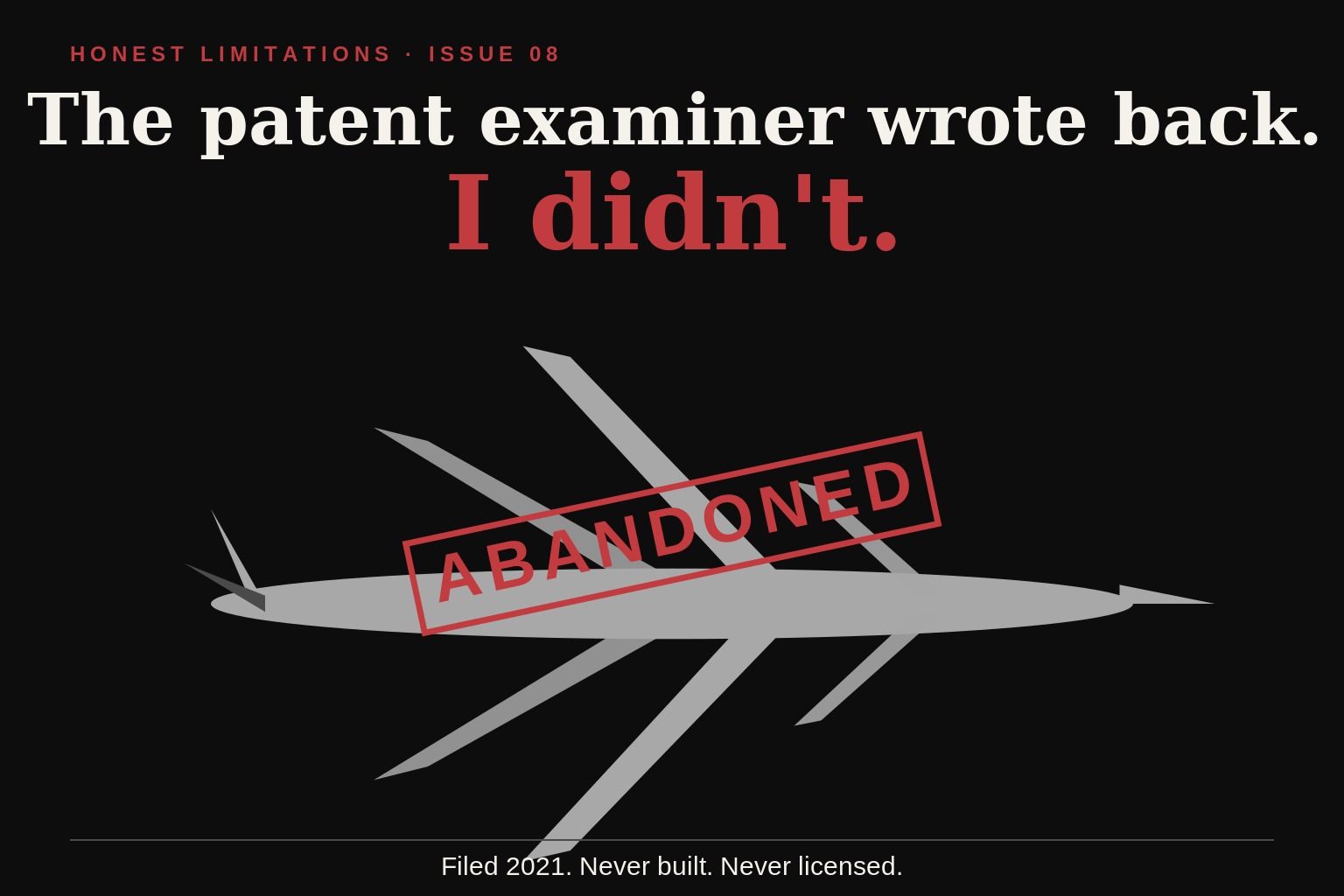
In February 2021 I filed a patent application for an aircraft wing system built from two wing sets per side instead of one — an inner wing carrying the structural load, an outer wing that could tilt, fold, or reposition. Wingspan creates real constraints on the ground: gate clearance, taxiway space, hangar capacity, aircraft storage. I thought a wing that could shrink on command eased some of that.
This wasn't a napkin sketch. I ran computational fluid dynamics simulations across several wing configurations, at three angles of attack each, and measured the lift and drag each one produced. The best of them cut the simulated wingspan by as much as 52%, from about 30.5 metres down to as little as 14.6 metres, while still generating more lift than the aircraft needed for level flight. On a computer, it worked.
Then an office action came back from the examiner — the ordinary next step almost every patent application goes through. I'd answered plenty of these before, on other filings, over thirty years.
This time, I didn't.
What I actually had
Not because I forgot. I sat with the deadline for a while and asked myself a question I hadn't been asking on my earlier filings: if the patent office says yes tomorrow, what do I actually have?
The honest answer was: a patent, and still no prototype, no development partner, and no clear route to a buyer. Simulations are cheap next to what comes after them. Turning this into something that flies means a structural engineering team, wind-tunnel and flight testing, and a certification process built for organizations with engineering staff, testing budgets, and decades of certification experience behind them — not an individual filing for around four hundred dollars.
Licensing it to one of those organizations meant convincing them that a wing system from an individual, backed by simulations and no built hardware, deserved engineering time over everything already moving through their own pipeline. I had no established relationship in that industry, and no affordable way to build one.
I could file the idea for four hundred dollars. Nobody tells you what it costs to make someone believe it.
The mistake, stated plainly
It would be easy to tell this as a story about a good decision — recognizing a limit and walking away before it cost more. That's true as far as it goes, but it skips the part that actually belongs in a Kill File.
My mistake was filing before I had a credible plan for what would happen after a grant. I had evidence the idea worked in simulation. I didn't have a route from a granted patent to an engineering partner, a customer, or a dollar. Letting the application go wasn't the failure. It's where I finally stopped making the one I'd already made.
Time added a second uncertainty on top of that. Even if I'd kept the application moving, I had no reason to assume the opportunity would sit still while I found the people and the money to pursue it. That's a real cost of prosecution I hadn't priced in going in — not a specific thing I can point to that happened to this filing, just a fact about how long these things take and how little control I have over what changes underneath them while they do.
What actually killed it
Not the wing. I stopped without ever resolving whether it would perform the way the simulations suggested outside of a computer. What killed it was doing the arithmetic on the plan around the invention instead of the invention itself, and finding nothing there strong enough to justify one more response, one more fee, one more year, when I already knew where the years after that would have to go.
That's a different gate than the ones I usually run here. It isn't "is this real" or "is this new." It's the one I've learned costs the most when I skip it: does the plan around the invention — the part where it turns into money — have a foundation, or am I assuming a grant is worth something on its own? For most of thirty years I ran that question late, at least once after paying for the answer the hard way — elsewhere on this site I've described the one patent I tried to enforce myself in federal court, and what that cost me. This time I ran it early enough that the only price was a filing fee and an unanswered letter.
Cause of death: I filed before establishing a credible route to the engineering support, funding, and industry partner the invention would need.
Caught at Gate Three — Does it have a foundation? — applied to the business plan, not the wing.
What survived
I still invent. I still file — several applications since this one, including ones that went on to be granted. What's different is a question I try to ask before I answer the first office action, not after the fifth: who might actually use this, what would they need to see before they believed it, and is there a realistic next step that puts it in front of them? "Someone will want it once it grants" isn't an answer to that. I used to let it stand in for one.
I still don't know whether the wing would have worked outside a simulation. I do know I had no credible plan for taking it further. That was enough to stop spending.
Samir Hanna Safar is an independent inventor with 23 granted U.S. patents. Honest Limitations publishes one failed idea a week — and what survived after it failed.
The published patent application is real: USPTO application 17/169,364, published as US 2021/0253248 A1, publicly listed as abandoned. The CFD figures (wingspan, lift, and drag by configuration) are drawn directly from that filing.
Drafting, computation and formalisation are carried out with the assistance of an AI system. The questions, the direction and every choice are mine, and I take full responsibility for them.